SAME BEHAVIOUR, DIFFERENT REASON
Two children, standing perfectly still
Two students are both standing still and listening to their teacher. One is listening because they are worried about being corrected. The other is listening because they see themselves as a respectful person who listens when somebody else is speaking.
The behaviour looks the same. The reason behind it is completely different.
Our goal is not simply children who behave well while an adult is watching. It is children who develop the values, habits and beliefs that mean they choose good behaviour for themselves.
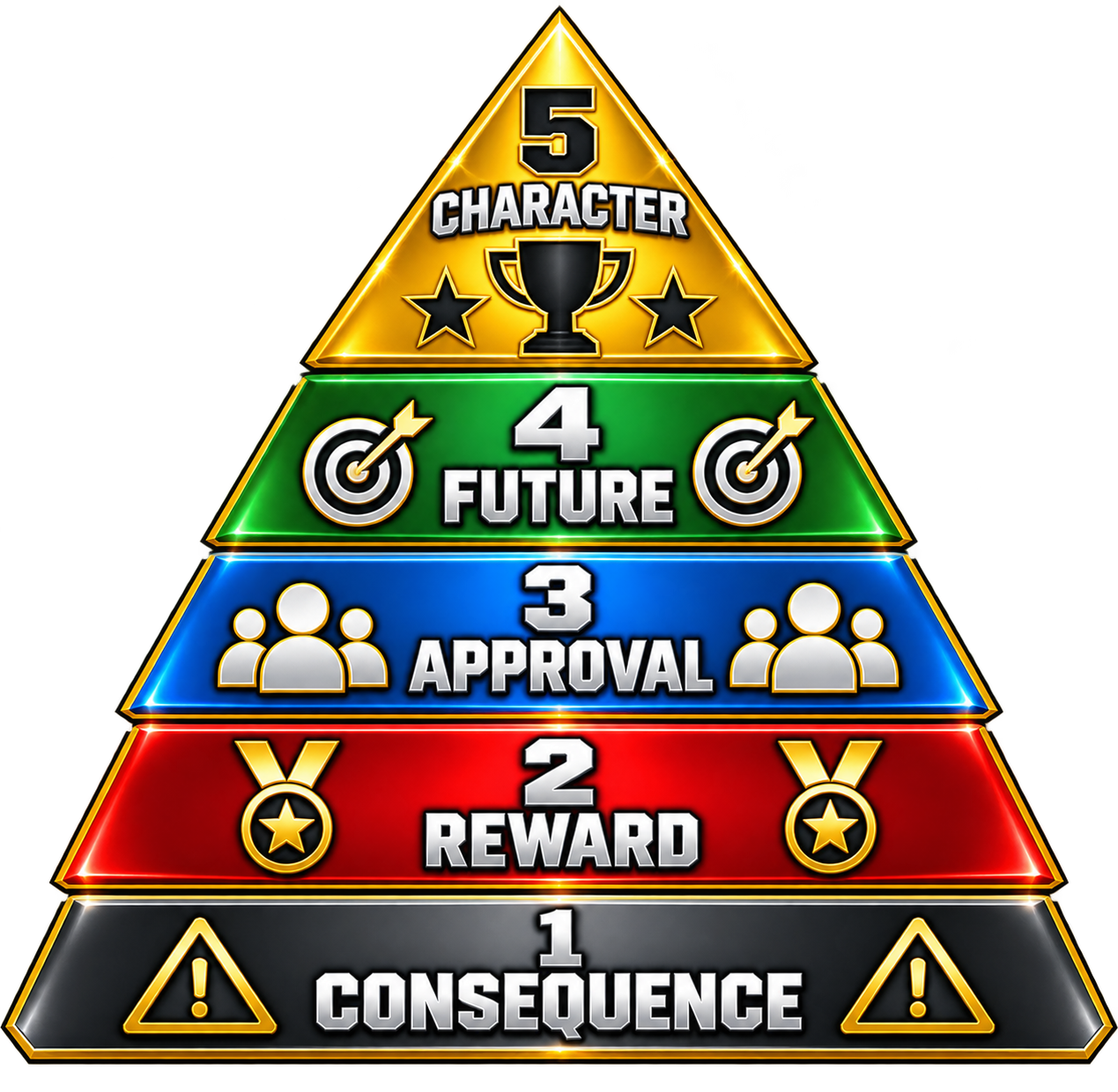
THE FIVE LEVELS
Consequence → Reward → Approval → Future → Character
Every child starts somewhere. Our role is to recognise where they are and help them move up.
Consequence
“I do it because I don’t want to get into trouble.”
The motivation comes almost entirely from outside the child. They listen because they do not want to be corrected, and stop misbehaving because there will be a consequence if they continue.
There is nothing wrong with starting here. Children need clear boundaries, rules and consequences. But if the only reason a child behaves well is because an adult is watching, we have not yet developed character.
How we help: Clear, fair and consistent boundaries, then helping the child see there are positive reasons for making the right choice.
Reward
“I do it because I want recognition.”
The child starts linking good choices with good outcomes: a stripe, praise, the next belt or a medal. Rewards are very useful, especially with younger children.
But reward is not the destination. We do not want a child who only works hard when there is something in it for them.
How we help: Using rewards to reinforce the right behaviour, while shifting the conversation from what they received to what they did to earn it. Not just “Here’s your sticker”, but “You earned that because you kept trying when that kick was difficult. That’s perseverance.”
Approval
“I do it because I want the people I respect to be proud of me.”
Relationships now matter. The child wants their instructor, their teacher, or Mum and Dad to be proud of them. They are starting to care about the standards of people they respect.
A strong relationship between teacher and student becomes incredibly powerful here.
How we help: Using that relationship well, while turning the child’s attention inward: from “I’m proud of you”, to “You should be proud of yourself”, to “Why are you proud of yourself?”
Future
“I understand why this matters.”
The child begins to understand the purpose behind what they are asked to do. They practise because “if I practise this properly, I’ll improve”, and keep going because “if I keep going when it’s difficult, I’ll become stronger.”
They are connecting what they do today with who they become tomorrow.
How we help: Explaining the why, and asking questions like “Why do you think we’re practising this?” and “What kind of person are you becoming by not giving up?”
Character
“This is just who I am.”
This is the destination. The behaviour no longer depends on a consequence, a reward, praise, or someone explaining the benefit. The child has made it their own.
“I listen because I’m a good listener.” “I don’t give up because I’m someone who keeps trying.” “I tell the truth because I’m an honest person.” Nobody needs to be watching.
How we help: Noticing and naming it when a child acts from character, so they recognise it in themselves.
OBEDIENCE OR CHARACTER?
Obedience can disappear when the adult leaves the room. Character goes with the child.
IN EVERY CLASS
Same front kick. Five different reasons.
The pyramid is not just a poster on the wall. It is part of how our instructors talk to children. Ask a class “Why are you trying so hard with that kick?” and you might hear:
We are no longer simply teaching a kick. We are teaching children to understand their own motivation.
QUESTIONS TO ASK AT HOME
Help your child move up
- “Why did you make that choice?”
- “Where are you on the pyramid today?”
- “What would the next level look like?”
- “Did you do that because someone was watching, or because that’s the person you’re becoming?”
- “Why are you proud of yourself?”
IT WORKS FOR ANYTHING
Not just martial arts
THE CHAMPIONS METHOD
What we teach. How we develop it. Why we do it.

Want this for your child?
Tell us where you are and what you are looking for. We will let you know about classes near you, our online classes, or how we can visit your child’s school.
We will only use your details to reply to your enquiry. See our Privacy Policy.